
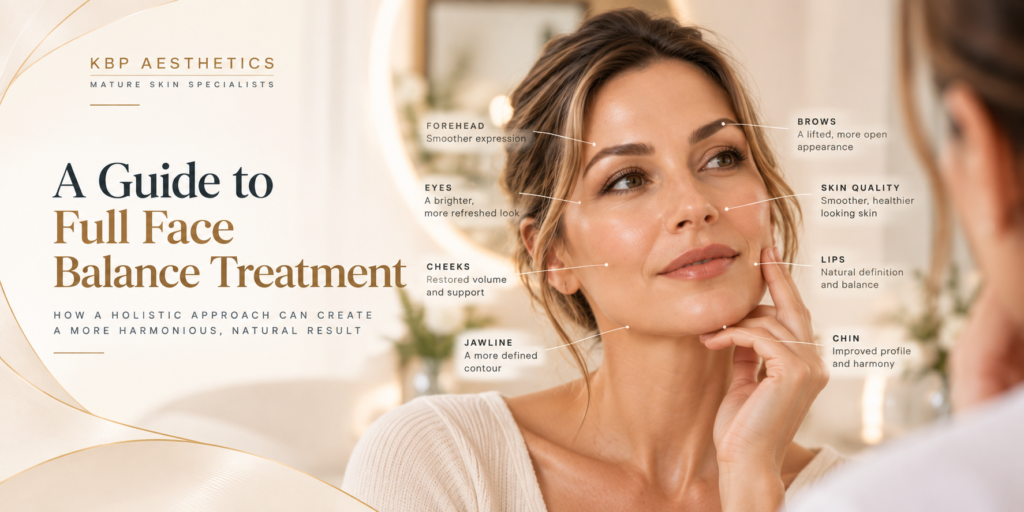
If you have ever looked in the mirror and felt that one feature seems slightly out of step with the rest of your face, you are usually not noticing a single problem. More often, you are noticing proportion. That is where full face balance treatment comes in. Rather than chasing isolated corrections, this approach looks at how the forehead, cheeks, lips, chin, jawline and skin quality work together to create a fresher, more harmonious result.
For many clients, this feels like a more considered alternative to booking one popular treatment and hoping for the best. A well-balanced face rarely relies on one area alone. Softening strong movement in the upper face, restoring support through the mid-face, refining the profile or improving skin texture can each play a part, but the right plan depends entirely on the individual sitting in the chair.
What full face balance treatment really means
Full face balance treatment is a personalised, non-surgical treatment strategy designed to improve overall facial harmony. The goal is not to make every feature larger, sharper or more pronounced. It is to assess where volume has reduced, where structure could be better supported, where expression lines may be affecting the appearance of tiredness, and how small adjustments can create a more polished whole.
This matters because the face is read as a complete picture. A client may focus on lips, for example, when the real issue is a lack of cheek support making the lower face feel heavier. Someone else may request jawline definition when chin projection is the missing element. In another case, the concern may not be volume at all, but skin quality, movement or asymmetry.
A balanced approach avoids overtreatment. It also tends to produce results that look more natural, because the aim is to maintain identity rather than change it.
Why facial balance matters more than a single feature
When aesthetic treatments are carried out in isolation, the result can sometimes feel incomplete. Treating one area without considering the rest of the face may improve that feature, but not always the overall appearance. This is one reason some people feel they have had treatment, yet still do not look as refreshed as they expected.
Facial ageing does not happen in neat sections. Volume loss in the cheeks can influence the under-eye area and nasolabial folds. Changes in the chin and jawline can affect profile balance. Repeated muscle movement can alter how alert or relaxed the face appears. Skin laxity and texture can shift the way light reflects across the face, which changes how youthful the skin looks.
A full face balancing plan respects those connections. It looks at the face in motion, at rest and from different angles. It also considers gender, age, facial anatomy and personal style. Some clients want a very subtle maintenance plan. Others are looking for more visible contour and definition while still keeping the result elegant and believable.
How full face balance treatment is assessed
The consultation is where this type of treatment either succeeds or fails. Proper facial balancing is not a menu choice. It begins with a detailed assessment of your facial proportions, movement, skin quality, medical suitability and treatment goals.
A practitioner may look at how the upper, mid and lower face relate to one another, whether the profile feels balanced, where support has reduced over time, and which concerns are structural versus skin-based. This is also the point where expectations need to be discussed honestly. Not every concern should be treated with filler, and not every client needs multiple injectable areas.
In a premium, practitioner-led setting, the consultation should feel unhurried and specific to you. That includes discussing what not to do. Sometimes the best treatment plan is staged over time rather than carried out in one appointment. Sometimes a client asking for more volume actually needs less product and better placement.
Treatments that may form part of full face balance treatment
The exact plan varies, but full face balance treatment often combines a small number of carefully selected treatments rather than a one-size-fits-all package.
Anti-wrinkle treatment may be used to soften expression lines in the forehead, frown or crow’s feet, but it can also help lift and refine the overall appearance when placed well. Dermal filler may restore volume in the cheeks, refine the lips, support the chin or define the jawline. Skin treatments may improve texture, luminosity and firmness so that the skin itself looks healthier and more even. In some cases, advanced treatments that support collagen remodelling and tightening may be more appropriate than adding volume.
This is where experience matters. A natural result relies on choosing the right tool for the concern, not forcing every issue into the same treatment category.
Full face balance treatment is not about looking done
One of the biggest misconceptions is that treating the full face means a dramatic transformation. In reality, the best full-face work is often difficult to identify. You may look fresher, better rested or more refined, without anyone being able to point to a single obvious change.
That is especially important for clients who value discretion. Many people want to look like themselves on a very good day, not like a different version of themselves. Balanced treatment should support your features, not compete with them.
Why treatment plans should be bespoke
Two clients can have the same concern and need completely different solutions. A tired appearance may come from hollowing in one person, skin laxity in another and heavy muscle pull in someone else. The treatment plan should reflect that.
This is also why copied trends rarely age well. Faces are individual. Bone structure, muscle activity, natural asymmetry and skin condition all influence what will look balanced. A bespoke plan takes these factors into account, which is far more reliable than asking for the same treatment you have seen on somebody else.
Who is a good candidate?
Full face balance treatment suits adults who want refined, natural-looking enhancement and are open to a personalised plan rather than a quick fix. It can work well for clients noticing early signs of ageing, those who feel their features have lost harmony over time, or those who want to improve profile balance and soft tissue support without surgery.
It also appeals to clients who are cautious. If you have avoided treatment because you do not want to look overfilled or obvious, a balanced approach is often the most sensible place to start. The focus is not on treating everything. The focus is on treating the right things, in the right way, at the right pace.
That said, suitability always depends on medical history, anatomy and expectations. Some clients may need to prioritise skin health before contouring. Others may be better served by spreading treatment over several visits to keep results controlled and measured.
What results should you expect?
A good result should feel coherent. You should not look as if one feature has been altered while the rest of the face has been left behind. Instead, the aim is for the face to appear more rested, supported and proportionate.
Results vary depending on the treatments involved. Anti-wrinkle treatment develops gradually. Filler can give more immediate structural change, though final settling still takes time. Skin and collagen-focused treatments often improve progressively. This is another reason full-face planning works well – it allows for realistic sequencing rather than rushing every concern into one day.
There is also a practical point here. More treatment is not always better treatment. Conservative amounts, reviewed properly, often produce the most sophisticated results. At KBP Aesthetics, that measured approach is central to achieving enhancement that still feels like you.
The value of a private, considered approach
Facial balancing requires judgement, not speed. In a high-volume setting, it is easy for treatment to become area-led rather than face-led. That can lead to disconnected results or recommendations based on popularity rather than need.
A quieter, appointment-only clinic experience offers space for proper planning, review and aftercare. For clients investing in their appearance, that matters. You are not only paying for product. You are paying for assessment, technique, restraint and an experienced eye for proportion.
That level of care is especially valuable if you are new to aesthetics or if you have previously had treatment elsewhere and felt the result was not quite right. A balanced treatment journey should leave you feeling informed, comfortable and confident in the plan.
Is full face balance treatment worth it?
If your goal is subtle improvement that makes sense across the whole face, it often is. The value lies in precision. Instead of repeatedly treating individual concerns in isolation, you are working towards an outcome that feels more complete and more natural.
The best candidates are usually those who understand that aesthetics is not about copying someone else’s face or fixing every line. It is about refinement, proportion and choosing treatments that support long-term confidence.
If you are considering treatment, start with a consultation that looks beyond one feature. The right plan should feel tailored, honest and calm from the outset. When facial balance is approached properly, the result is not a new face. It is a version of your own that looks fresher, softer and more in tune with how you want to feel.