
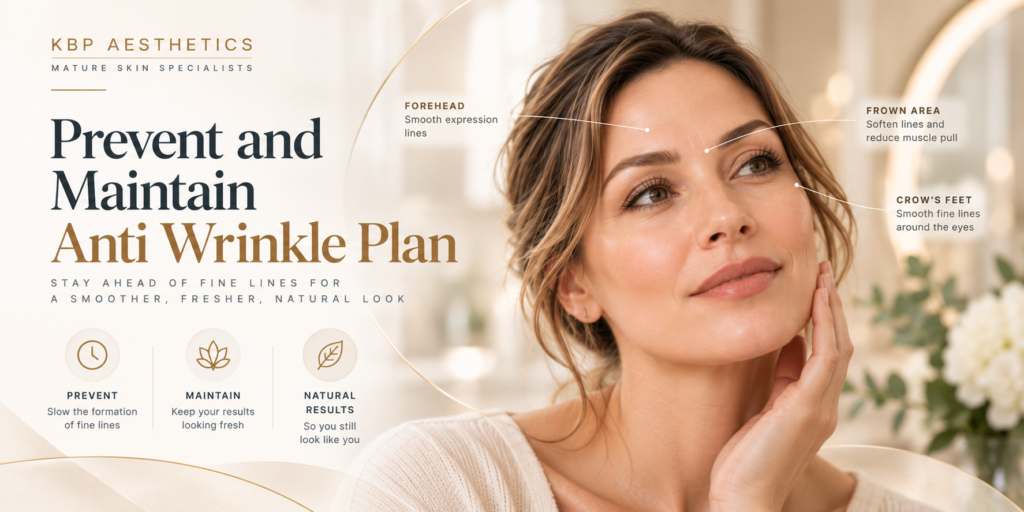
Fine lines rarely appear all at once. More often, they show up in the places you use most – the forehead when you raise your brows, the frown area when you concentrate, and around the eyes when you smile. A prevent and maintain anti wrinkle plan is designed around that reality. Rather than waiting for lines to deepen and then trying to correct them all at once, it focuses on measured, well-timed treatment that keeps the face looking refreshed, balanced and entirely like you.
For many clients, that approach feels far more sensible than chasing dramatic change. The goal is not to remove expression or create a frozen finish. It is to reduce the repetitive muscle movement that gradually etches lines into the skin, while keeping the overall result soft, polished and natural.
What a prevent and maintain anti wrinkle plan really means
A good plan is not simply having anti-wrinkle treatment whenever lines start to bother you. It is a structured approach based on your facial movement, skin quality, age, treatment history and how subtle you want the result to be.
Prevention usually applies to clients who are starting to notice movement lines but do not yet have deep static creasing at rest. In that stage, carefully dosed anti-wrinkle treatment can reduce the repeated folding of the skin, which may help delay deeper line formation over time.
Maintenance is slightly different. This is for clients who already have visible lines and want to keep them softened consistently. In these cases, treatment is used to control muscle activity, support smoother skin appearance and avoid the cycle of letting results fully wear off before restarting again.
The reason this matters is simple. Anti-wrinkle treatment tends to work best when it is planned, not rushed. Sporadic appointments can still help, but a considered schedule often gives a more refined outcome because it allows the face to be managed gradually rather than corrected in peaks and troughs.
Why prevention often looks more natural than correction
There is a common assumption that aesthetic treatment should only begin once ageing is obvious. In practice, earlier intervention is often what allows results to stay discreet.
If lines are treated while they are still mostly dynamic, meaning they appear with movement rather than sitting permanently in the skin, smaller and more conservative dosing is often enough. That usually means preserved expression, softer transitions and less need for stronger correction later.
By contrast, once lines become etched and the skin has lost some elasticity, anti-wrinkle treatment may still improve their appearance, but it may not erase them completely. At that stage, skin quality, collagen support and volume changes can also be part of the picture. This is where a bespoke plan becomes important, because treatment may need to address more than one cause of facial ageing.
For clients who value understated results, prevention is often the route that keeps everything looking effortless. Friends may simply say you look well rested or fresher, rather than noticing that anything specific has been done.
The areas most often included in an anti wrinkle maintenance plan
Most plans focus on the upper face because that is where repetitive expression tends to create lines first. The forehead, frown area and crow’s feet are the most commonly treated zones.
That said, not every client needs all three. Some people have stronger frown movement and barely use their forehead. Others develop forehead lines early but maintain a softer brow pattern. Around the eyes, dosage and placement must be especially considered, because the aim is to soften creasing without making the smile look restricted.
A prevent and maintain anti wrinkle plan may also evolve over time. In your late twenties or early thirties, the focus may be entirely on movement management. Later on, the plan may include skin treatments or other non-surgical options to support texture, firmness and overall facial balance.
This is why a proper consultation matters. A face should never be treated from a standard formula. It should be assessed as a whole.
How often should anti-wrinkle treatment be maintained?
There is no single timetable that suits everyone. Metabolism, muscle strength, treatment dose and aesthetic goals all affect longevity. As a general guide, many clients maintain anti-wrinkle treatment every three to four months, but some stretch a little longer while others prefer more regular review.
The best schedule is usually the one that prevents full return of strong movement without overtreating. If treatment is repeated too late each time, lines can re-establish and consistency is harder to maintain. If it is done too frequently without proper assessment, the result may feel heavier than intended.
A practitioner-led clinic will usually review how your face responds rather than setting a fixed diary pattern and forgetting about it. That is particularly important if your goal is a fresh, natural look instead of a uniformly frozen one.
For first-time clients, a review appointment is just as important as the treatment itself. It allows any adjustment to be made carefully and helps build a plan based on your own response, not assumption.
Why a personalised anti wrinkle plan matters more than price offers
When clients are choosing aesthetic treatment, it can be tempting to compare only on cost or convenience. But anti-wrinkle treatment is not a one-size-fits-all purchase. The result depends on assessment, anatomy, dosage strategy, follow-up and restraint.
A premium treatment experience is not about adding unnecessary steps. It is about making sure each step has a purpose. If your practitioner understands facial balancing, muscle behaviour and long-term ageing patterns, your plan can be designed to preserve what already looks good while softening what is starting to change.
That often means saying no to unnecessary treatment. It can also mean recommending a phased approach rather than trying to do everything at once. For clients who want quality over speed, this is usually where trust is built.
At KBP Aesthetics, that kind of planning is central to the client experience. The emphasis is on calm, one-to-one care and natural-looking enhancement, not high-volume treatment for the sake of it.
What to expect from a proper consultation
A meaningful consultation should do more than confirm which area you want treated. It should assess how your face moves, whether lines are dynamic or static, how balanced your upper face appears, and whether your concerns are best treated with anti-wrinkle injections alone.
You should also expect a discussion around your lifestyle, previous treatment, expectations and how subtle you want the result to be. Someone who wants a very soft reduction in movement may need a different plan from someone who prefers a smoother, longer-lasting finish.
Medical suitability and aftercare should be addressed clearly. So should timing. If you have an event coming up, treatment should be planned appropriately rather than squeezed in without thought.
The best consultations leave you feeling informed, not sold to. That difference is significant.
Supporting your anti wrinkle plan between appointments
Treatment can only do part of the work. How your skin is cared for between appointments influences how well your overall result holds up.
Daily SPF is one of the most worthwhile habits for preserving smoother skin, particularly if forehead lines, crow’s feet or pigmentation are concerns. Good hydration, a consistent skincare routine and treatments that support skin quality can also make a visible difference. If the skin is dehydrated, dull or damaged by sun exposure, lines often appear more prominent even when muscle movement is reduced.
There is also a lifestyle element. Stress, poor sleep and smoking can all contribute to a more tired, creased appearance. That does not mean aesthetic treatment is pointless if life is busy. It simply means the most polished result usually comes from a combination of treatment and maintenance, not one in isolation.
When to start if you are unsure
If you are noticing lines that linger after your expression relaxes, or if one area of movement is becoming more dominant, it may be the right time to seek advice. That does not automatically mean treatment is needed immediately. Sometimes reassurance, monitoring or a future plan is more appropriate.
What matters is that the decision is made with clinical judgement and a realistic understanding of what subtle treatment can achieve. For some clients, starting earlier means less intervention overall. For others, waiting and focusing on skincare first is perfectly reasonable.
The right plan should fit your face, your age, your goals and your comfort level. There is no prize for starting too soon, and no benefit in waiting until concerns feel harder to manage.
A well-designed anti-wrinkle plan should never make you look done. It should simply help you stay ahead of the changes you have started to notice, with enough care and precision that your reflection still feels familiar – only fresher, smoother and quietly more confident.