
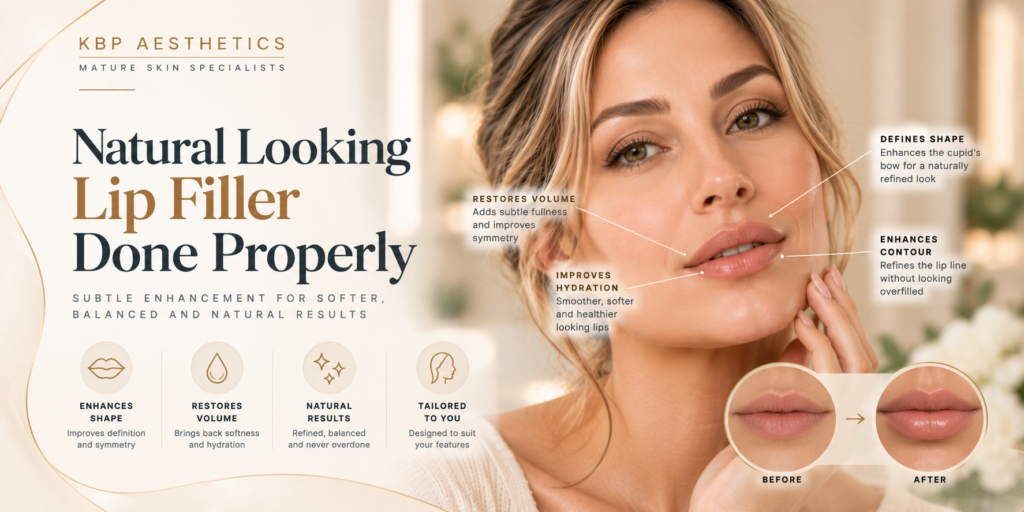
The lips are often one of the first features people notice, which is exactly why poor treatment stands out so quickly. Natural looking lip filler is not about making lips look obviously treated. It is about restoring softness, defining shape, improving symmetry where possible and adding structure in a way that still looks like you.
For many clients, the goal is not bigger lips. It is better lips. That difference matters. A well-planned treatment should suit the rest of the face, support facial balance and respect your natural anatomy rather than chasing a trend.
What natural looking lip filler actually means
Natural results are often described as subtle, but subtle does not mean ineffective. It means the enhancement is measured. The border may be more refined, the cupid’s bow slightly clearer, the top and bottom lip more balanced, and the lips better hydrated and supported. Friends may notice you look fresher or more polished without being able to immediately identify why.
This approach is particularly important if you want your treatment to sit comfortably within your everyday life. Many clients want to feel more confident in photographs, with lipstick, or without make-up, but do not want the look of overfilled lips that dominate the face.
Natural looking lip filler also depends on proportion. The lips should make sense within the wider facial structure. A treatment that looks acceptable in isolation can still feel heavy if it does not suit the chin, nose, jawline or natural lip movement. Good treatment planning always looks beyond the lips alone.
Why natural looking lip filler is more difficult than it sounds
The phrase sounds simple, but achieving it takes judgement. Lips are dynamic, highly visible and unique to each person. The amount of natural tissue, skin quality, age-related volume change, asymmetry, tooth support and lip mobility all affect what will look refined.
A younger client may want a little more shape and presence while keeping a soft finish. Someone older may be more concerned with restoring definition lost over time, softening fine lines around the mouth or replacing support that has gradually reduced. In both cases, the best result usually comes from restraint.
This is where practitioner skill matters. It is not just about placing filler. It is about knowing when less is enough, when a staged approach is safer, and when lips are not the first area to treat if facial balance is the real concern.
The consultation matters more than the syringe
A quality result starts before any treatment begins. The consultation should cover your goals, medical suitability, previous treatment history and what is realistically achievable with your current anatomy. If you arrive asking for a certain volume, a responsible practitioner should still assess whether that amount is appropriate.
This is particularly relevant for clients who say they want a natural finish but bring reference images that show a much fuller result. That is not a problem in itself, but it does need an honest conversation. Natural is personal. What feels subtle to one client may feel too noticeable to another.
At KBP Aesthetics, this kind of discussion is central to treatment planning. The aim is not to rush towards a popular look. It is to create a result that sits well on your face, suits your age and style, and still feels recognisably you.
What creates a natural lip result
Volume is only one part of lip filler, and often not the most important part. Shape, support and technique usually make the biggest difference. In many cases, a small amount of filler can improve the overall appearance far more effectively than a larger amount placed without clear strategy.
A natural-looking outcome tends to rely on a few things working together. The lip border should be defined but not rigid. The body of the lip should have gentle support rather than a swollen or overprojected look. The profile should remain balanced, and the lips should move naturally when you speak and smile.
Hydration also plays a role. Certain products and careful placement can improve the appearance of dryness and creasing, which gives the lips a softer, healthier finish. This is often what clients are responding to when they say someone looks naturally refreshed.
When less filler gives a better outcome
There is a common assumption that if a little filler looks good, more will look better. In lips, that is rarely true. Once the tissue is overfilled, shape can blur, the upper lip can begin to project too far, and the result may become more obvious than intended.
For clients seeking natural looking lip filler, a staged approach is often the better option. Starting conservatively allows swelling to settle, shape to soften and the true result to become visible before deciding whether more is needed. It is a more controlled way to treat and usually leads to a more elegant outcome.
This is especially important if you are new to lip filler. First treatments should not feel like a dramatic leap. They should feel like a considered adjustment.
Natural does not mean identical or perfect
Lips are naturally asymmetrical. Most people have one side that sits slightly differently, a top lip that is less full than the lower lip, or small variations in movement when they smile. Filler can improve balance, but it cannot always make the lips perfectly even, particularly in motion.
That is why honest expectations matter. A good practitioner should explain what can be improved and what should be left alone. Chasing perfect symmetry can quickly lead to over-treatment, and over-treatment is usually the point where natural results are lost.
The same applies to ageing lips. If volume loss, smoker’s lines or reduced support around the mouth are the main concern, the lips may benefit from treatment, but sometimes the best result comes from considering the surrounding areas as well. Full facial harmony nearly always looks more refined than treating one feature in isolation.
Choosing the right practitioner for subtle lip filler
If natural results are your priority, choose your practitioner with care. Look beyond social media trends and before-and-after images that only show dramatic change. A premium clinic should be able to explain how it assesses facial balance, how treatment is tailored, what product is being used and what aftercare and review process are included.
You should also expect a calm, private experience rather than a fast appointment built around volume sales. Lip filler is not a casual purchase. It is a medical aesthetic treatment, and it deserves proper consultation, appropriate consent and careful follow-up.
Subtle work often requires more expertise, not less. It is easier to make lips look bigger than it is to make them look quietly better.
What to expect after treatment
Even the best lip filler can look less natural in the first few days. Swelling, tenderness and temporary unevenness are common early on, which is why immediate judgement is rarely useful. Clients sometimes worry that the lips look too full straight after treatment, only to find that once settled they appear soft and balanced.
Following aftercare advice is part of protecting your result. You should be given clear guidance on what to expect, how to reduce avoidable irritation and when to contact the clinic if you have concerns. Review appointments are also valuable, particularly if your treatment plan is conservative and designed in stages.
Patience matters here. Natural results are often appreciated more fully once the lips have settled and integrated.
Is natural looking lip filler right for everyone?
Not always, and that is worth saying clearly. Some clients do want a more enhanced aesthetic, and provided treatment is safe and fully informed, that is their choice. But if your preference is polished, balanced and discreet, then natural looking lip filler is usually the right direction.
It is especially suited to clients who want to maintain a professional appearance, who are cautious about looking overdone, or who simply want to feel fresher without changing their face. It also tends to age better. Trends move quickly, but balanced facial work remains attractive because it respects proportion.
The best lip filler should not announce itself the moment you walk into a room. It should support your features, photograph well, sit comfortably with the rest of your face and help you feel more confident without feeling unlike yourself.
If that is the result you want, the answer is rarely more product or a quicker appointment. It is careful assessment, refined technique and a practitioner who is confident enough to prioritise restraint. That is usually where the most beautiful work begins.